

Industrial pH control is essential for maintaining product quality, protecting equipment, and ensuring stable operating conditions. Changes in acidity and alkalinity can affect chemical reactions, wastewater treatment efficiency, corrosion rates, and downstream processes. Selecting the right chemical treatment is therefore an important part of industrial process management. Sodium bicarbonate (NaHCO₃) is used as a mild alkaline compound in applications requiring alkalinity adjustment and controlled acid neutralization. Unlike strong bases, it contributes to pH stability through the bicarbonate buffering system while providing a measurable neutralization capacity. Understanding how sodium bicarbonate supports industrial pH control requires examining its chemical properties, buffer capacity, neutralization efficiency, and dosing requirements. These factors help determine when the compound is suitable for water treatment, manufacturing, and other industrial applications that require reliable pH management and optimized chemical dosage.
Understanding the Role of Sodium Bicarbonate in Industrial pH Control
Sodium bicarbonate is a water-soluble inorganic compound with the chemical formula NaHCO₃. When dissolved in water, it separates into sodium (Na⁺) and bicarbonate (HCO₃⁻) ions. The bicarbonate ions participate in chemical equilibria involving carbonic acid (H₂CO₃), dissolved carbon dioxide (CO₂), and carbonate ions (CO₃²⁻).
These reactions explain how sodium bicarbonate influences water chemistry. Rather than behaving like a strong base, it primarily supplies alkalinity and helps neutralize incoming acids. This makes it useful in processes where gradual pH adjustment and resistance to sudden fluctuations are more important than rapid pH elevation.
Chemical Properties and the pH of Sodium Bicarbonate
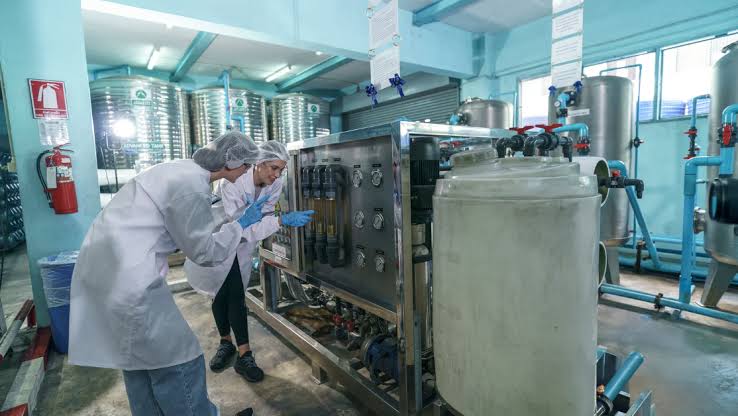
The pH of sodium bicarbonate solutions is generally mildly alkaline. However, the measured value depends on concentration, temperature, dissolved carbon dioxide, and the composition of the water. Therefore, it should not be considered a fixed value independent of preparation and measurement conditions. Once dissolved, bicarbonate ions participate in reversible acid-base reactions. Their interaction with hydrogen ions is particularly important because it allows the compound to reduce acidity while contributing to the carbonate buffering system.
Understanding the Difference Between pH and Alkalinity
pH measures the activity of hydrogen ions in a solution, indicating its current acidic or alkaline condition. Alkalinity, in contrast, represents the capacity of water to neutralize added acids.
This distinction is important in industrial treatment systems. Adding sodium bicarbonate can increase total alkalinity without necessarily causing a substantial immediate increase in pH. The resulting change depends on the existing chemical equilibrium and dissolved carbon dioxide levels. For accurate process management, operators should monitor both parameters rather than relying exclusively on pH measurements.
Buffer Capacity and pH Stability in Industrial Processes
Buffer capacity describes a solution’s ability to resist changes in pH when acids or bases are introduced. Industrial water systems frequently experience variations in chemical composition due to changing raw materials, production conditions, and wastewater inputs.
The bicarbonate system helps moderate these fluctuations by maintaining a balance between bicarbonate and carbonic acid. Its effectiveness depends on the available buffering components and the chemical conditions of the solution.
- How the Bicarbonate Buffer System Works
When an acidic substance enters the solution, bicarbonate ions react with hydrogen ions to form carbonic acid. Carbonic acid can subsequently decompose into water and carbon dioxide:
HCO₃⁻ + H⁺ ⇌ H₂CO₃ ⇌ CO₂ + H₂O
This reaction reduces the concentration of free hydrogen ions and limits the resulting pH change. The buffering effect is not unlimited. As acidic inputs consume available bicarbonate, the system gradually loses its capacity to resist further changes.
- Factors Affecting Buffer Capacity
Several variables influence bicarbonate buffering performance:
Bicarbonate concentration: Greater availability generally increases the capacity to neutralize incoming acids.
- Acid loading: Frequent or substantial acid inputs consume bicarbonate reserves.
- Carbon dioxide concentration: Dissolved CO₂ affects the balance between carbonic acid and bicarbonate.
- Temperature: Temperature changes influence gas solubility and chemical equilibrium.
- Water composition: Other dissolved ions and buffering compounds can affect total alkalinity.
Understanding these factors helps engineers maintain stable operating conditions and determine appropriate chemical feed rates.
Neutralization Efficiency of Sodium Bicarbonate
In addition to its buffering properties, sodium bicarbonate acts as a neutralizing agent in acidic aqueous systems. Its performance depends on the amount of available bicarbonate, the characteristics of the acid, and the operating conditions. Its relatively mild alkaline behavior makes it suitable for applications requiring controlled acid neutralization rather than rapid or substantial pH elevation.
Acid Neutralization Mechanism
Bicarbonate ions react with hydrogen ions to produce carbonic acid, which can subsequently form water and carbon dioxide:
HCO₃⁻ + H⁺ → CO₂ + H₂O
From a stoichiometric perspective, one mole of sodium bicarbonate can neutralize approximately one mole of hydrogen ions. With a molar mass of approximately 84.01 g/mol, 84.01 grams of pure sodium bicarbonate provide one equivalent of acid-neutralizing capacity.
Actual treatment performance also depends on mixing, reaction conditions, acid composition, and the desired final alkalinity.
Factors Influencing Neutralization Performance
The main factors affecting neutralization efficiency include:
Acid concentration and composition: Different acids contribute different quantities of hydrogen ions per mole.
- Initial alkalinity: Existing bicarbonate and other alkaline compounds influence additional chemical requirements.
- Mixing efficiency: Adequate mixing improves contact between bicarbonate and acidic components.
- Dissolution rate: Preparation conditions and particle characteristics influence chemical availability.
- Carbon dioxide management: Gas accumulation or release can affect equilibrium conditions and measured pH.
Comparison with Other pH Adjustment Chemicals
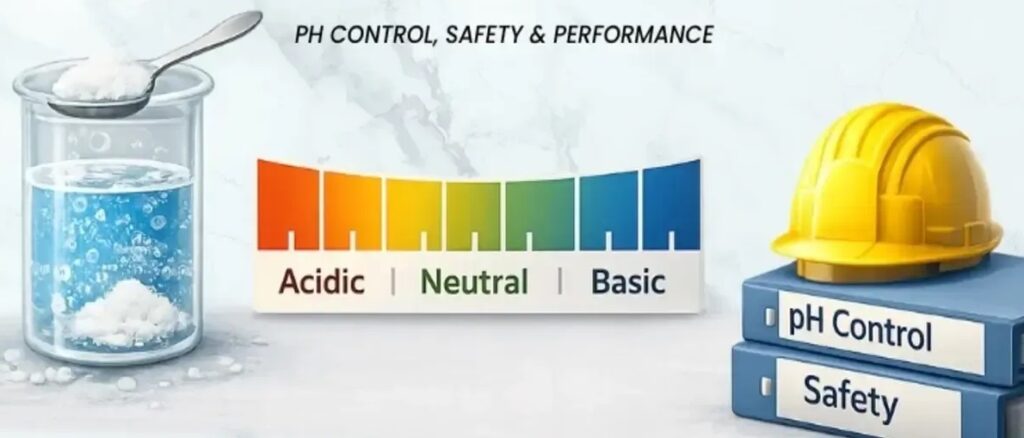
Sodium bicarbonate is one of several chemicals used in industrial pH management. Other common options include sodium hydroxide, sodium carbonate, and calcium hydroxide.
| Chemical | Main characteristic | Typical application |
| Sodium bicarbonate (NaHCO₃) | Mild alkalinity source and buffering agent | Controlled alkalinity adjustment |
| Sodium hydroxide (NaOH) | Strong base | Rapid and substantial pH elevation |
| Sodium carbonate (Na₂CO₃) | More alkaline than bicarbonate | Higher alkalinity requirements |
| Calcium hydroxide [Ca(OH)₂] | Strong alkaline compound | Bulk neutralization and wastewater treatment |
The appropriate choice depends on the target pH, treatment requirements, chemical consumption, equipment compatibility, and potential treatment residues. Sodium bicarbonate is particularly useful when gradual alkalinity addition and buffering are priorities.
Chemical Dosage Optimization for Industrial pH Control
Correct chemical dosing is essential for maintaining treatment efficiency and controlling operating costs. Insufficient sodium bicarbonate may leave a system vulnerable to acidification, while excessive addition can increase sodium concentrations and raise alkalinity beyond the required level. Effective industrial pH management therefore requires dosage calculations based on actual water chemistry, acid demand, and process conditions.
Calculating the Required Sodium Bicarbonate Dosage
The theoretical quantity of sodium bicarbonate can be estimated using the acid-neutralization reaction:
Required NaHCO₃ (g) = Acid demand (eq) × 84.01 ÷ Purity fraction
For example, consider an industrial treatment system with an acid demand of 10 equivalents and sodium bicarbonate purity of 99%:
Required mass = (10 × 84.01) ÷ 0.99
Required mass ≈ 848.6 g
The purity correction increases the required mass because a product containing 99% active sodium bicarbonate provides slightly less neutralizing capacity per gram than a pure compound. This calculation represents a theoretical requirement. Actual operating dosage may differ because of mixing limitations, variable acid loads, and the need to maintain residual alkalinity.
Importantly, pH alone cannot determine the required chemical quantity. Two water samples with identical pH values may have very different acid-neutralizing demands. Titration and alkalinity measurements are therefore valuable for establishing practical dosing requirements.
Practical Methods for Optimizing Chemical Dosage
Industrial dosage optimization combines laboratory testing, process monitoring, and controlled chemical addition.
- Measure initial pH and total alkalinity before determining the required dose.
- Use titration or bench-scale testing to evaluate bicarbonate demand.
- Prepare solutions with consistent concentrations.
- Introduce the chemical gradually and allow sufficient mixing time.
- Monitor pH and alkalinity to evaluate treatment performance.
- Adjust feed rates when influent composition or process flow changes.
For continuous treatment systems, automated dosing equipment connected to calibrated monitoring instruments can improve consistency. Product quality also matters. Selecting Industrial Grade Sodium Bicarbonate with appropriate purity, moisture content, and particle characteristics helps ensure consistent preparation and chemical delivery. Specifications should always match the intended industrial application.
Industrial Applications of Sodium Bicarbonate
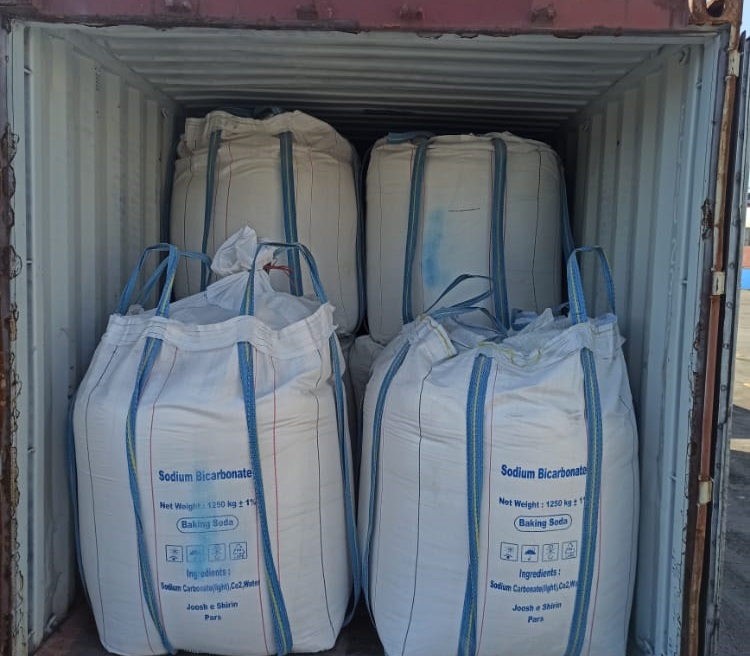
Sodium bicarbonate supports several industrial applications through its buffering, neutralizing, and alkaline properties. Its function varies depending on whether it is used in aqueous treatment systems or gas-cleaning processes.
- Water and Wastewater Treatment
In water treatment, sodium bicarbonate primarily supplies alkalinity. It can help stabilize pH in low-alkalinity water and provide bicarbonate ions required by certain biological treatment processes. In wastewater treatment, sufficient alkalinity is important for maintaining suitable conditions for biological reactions such as nitrification. When alkalinity becomes depleted, pH may decline and negatively affect microbial activity. Controlled bicarbonate addition can help restore the available buffering capacity.
A related application is pool water pH balance. Sodium bicarbonate is commonly used to increase total alkalinity in swimming pools, helping reduce sudden pH fluctuations. It is primarily an alkalinity increaser rather than a chemical intended for rapid pH elevation.
- Industrial Processing and Manufacturing
Various manufacturing operations require controlled acidity and alkalinity to maintain product consistency and predictable reaction conditions. Sodium bicarbonate can be incorporated into selected aqueous processes where gradual neutralization or alkalinity supplementation is required.
Its suitability depends on process formulation, chemical compatibility, and product specifications. Engineers should also consider sodium accumulation, dissolved solids, and potential carbon dioxide formation during neutralization.
- Flue Gas Treatment and Air Pollution Control
Another important application is flue gas treatment, particularly in dry sorbent injection systems. In these processes, finely ground sodium bicarbonate is injected into industrial gas streams to react with acidic pollutants such as sulfur dioxide (SO₂), hydrogen chloride (HCl), and hydrogen fluoride (HF).
At elevated temperatures, sodium bicarbonate decomposes into sodium carbonate, carbon dioxide, and water:
2NaHCO₃ → Na₂CO₃ + CO₂ + H₂O
The resulting sodium carbonate reacts with acidic gas components, producing solid reaction products that can be collected using particulate control equipment such as baghouse filters.
This application should be distinguished from aqueous pH control. It involves acid neutralization in the gas phase through solid-gas reactions, not direct adjustment of a liquid’s pH. Performance depends on temperature, particle size, contact time, gas composition, and reagent dosage.
Conclusion
Sodium bicarbonate supports industrial pH management through alkalinity adjustment, buffering, and acid neutralization. Its mild alkaline behavior makes it suitable for processes requiring controlled chemical addition rather than rapid pH elevation. Successful treatment depends on understanding the relationship between pH and alkalinity, calculating actual acid demand, and selecting an appropriate chemical feed rate. With consistent product quality, reliable monitoring, and optimized chemical dosage, sodium bicarbonate delivers effective industrial pH control across suitable water treatment and manufacturing applications.
Frequently Asked Questions
Sodium bicarbonate supplies bicarbonate ions that neutralize hydrogen ions and contribute to the carbonate buffering system. This helps increase alkalinity and moderate pH fluctuations in suitable aqueous processes.
It primarily increases total alkalinity, although it can also raise pH depending on the initial water chemistry. The magnitude of the pH change depends on factors such as dissolved CO₂ and existing buffer capacity.
The required dosage is estimated from acid demand, initial alkalinity, product purity, and treatment volume. Laboratory titration and controlled process testing help determine the practical operating dose.
Yes. In dry sorbent injection systems, sodium bicarbonate reacts with acidic flue gas pollutants, including SO₂ and HCl. This is a gas-phase neutralization process rather than conventional liquid-phase pH adjustment.