
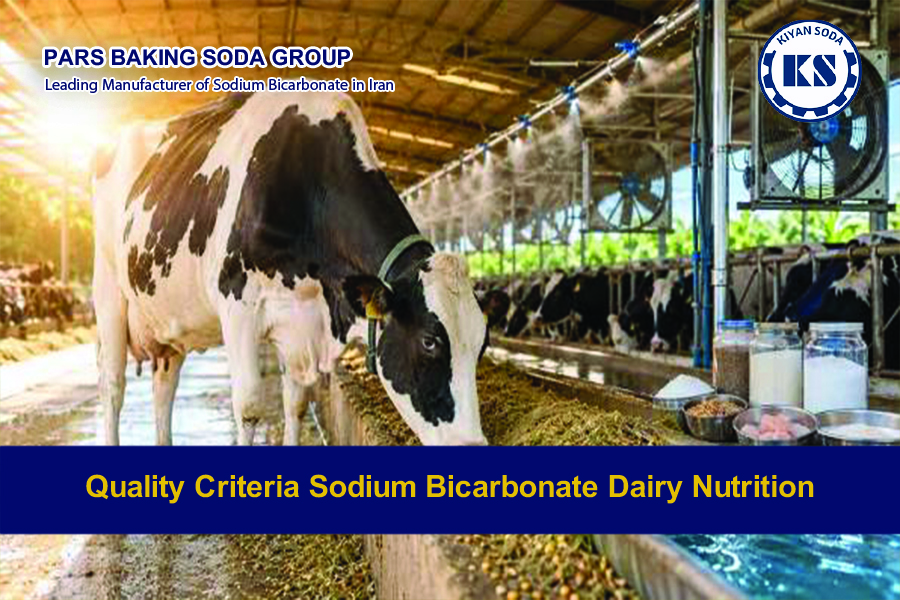

Sodium bicarbonate is widely used in commercial dairy feed formulations, but selecting a suitable product involves more than confirming its chemical identity or purity. Feed manufacturers must evaluate properties that influence storage, handling, dosing, mixing, and product consistency. These include sodium bicarbonate content, impurity levels, particle size distribution, moisture, solubility, bulk density, and flowability. The quality criteria sodium bicarbonate dairy nutrition requires should therefore cover both chemical composition and physical behavior. A product may meet purity requirements but still create processing difficulties if it absorbs moisture, forms lumps, or flows inconsistently through handling equipment.
Understanding Sodium Bicarbonate Quality in Commercial Dairy Feed
Product quality in feed manufacturing combines chemical composition, physical characteristics, consistency, and compliance with applicable specifications. These factors determine whether an ingredient can be handled and incorporated into a ration reliably.
The Role of Product Specifications in Feed Manufacturing
Sodium bicarbonate (NaHCO₃) is an inorganic compound that supplies sodium and bicarbonate ions. In dairy feed production, it is incorporated into formulated rations or premixes according to nutritional requirements. Its suitability also depends on its behavior during unloading, storage, conveying, weighing, and mixing. For example, a powder that absorbs moisture or forms compacted lumps may be difficult to transfer through automated equipment. Variations between production batches can also complicate quality control, even when individual deliveries meet minimum chemical specifications.
Therefore, the quality criteria sodium bicarbonate dairy nutrition involves should address the complete supply and manufacturing process rather than relying on a single laboratory result.
Why Chemical Purity Alone Does Not Define Quality
Chemical purity indicates the proportion of sodium bicarbonate in a sample, but it does not describe every characteristic relevant to feed production. Two products with comparable purity may differ in particle size, moisture content, bulk density, and flow behavior. These differences can affect storage, transportation, dosing, and distribution within a feed mixture. Consequently, purity certificates should be reviewed alongside physical specifications and batch consistency data.
Chemical Properties That Determine Feed-Grade Sodium Bicarbonate Quality

Chemical specifications establish whether a material has the expected composition and whether potentially undesirable substances are controlled. When evaluating feed-grade sodium bicarbonate, manufacturers should distinguish between purity, sodium content, and impurity levels.
- Purity and Sodium Bicarbonate Content
Purity is generally expressed as the percentage of NaHCO₃ in the product. Commercial feed-grade specifications commonly establish a minimum sodium bicarbonate content, although the exact requirement depends on the applicable standard and supplier specification. For example, ARM & HAMMER reports a minimum sodium bicarbonate content of 99.0% and a minimum sodium content of 27.1% for its feed-grade product. These figures provide a commercial reference, not universal requirements.
The theoretical sodium proportion in pure sodium bicarbonate is approximately 27.4% by mass. Comparing declared sodium content with the sodium bicarbonate assay can help manufacturers identify inconsistencies in product documentation.
- Sodium Content, Impurities, and Chemical Consistency
Sodium content represents the amount of sodium contributed by a given quantity of ingredient, but it does not independently confirm complete chemical quality. Manufacturers should also review relevant impurity limits, including chloride, insoluble matter, and potentially harmful trace elements. The substances and acceptable limits depend on the intended feed application and regulatory requirements in the destination market.
Batch consistency is equally important. Suppliers should demonstrate that successive deliveries remain within the agreed specification. Changes in assay or impurity levels may require additional checks before a material is released for production.
- Acid-Neutralizing Capacity and Chemical Identity
Acid-neutralizing capacity describes the amount of acid a substance can neutralize under defined test conditions. For sodium bicarbonate, this property is related to its chemical identity and concentration, but it is not identical to a purity result. A product containing less active sodium bicarbonate may provide lower neutralizing capacity per unit of material. However, a purity assay should not replace a dedicated neutralizing-capacity test when the purchasing specification requires one.
Physical Properties Affecting Handling, Dissolution, and Feed Processing
Physical properties determine how sodium bicarbonate behaves as a powder during commercial production. Although they do not necessarily change its chemical identity, they influence handling reliability and processing performance. Accordingly, the quality criteria sodium bicarbonate dairy nutrition should include measurable physical characteristics alongside chemical analysis.
Particle Size Distribution and Powder Behavior
Particle size distribution describes the proportion of particles within different size ranges. It provides more information than a single average diameter because two products with the same median size may contain different proportions of fine and coarse particles. Particle size can influence powder flow, dust formation, segregation, and dispersion during mixing. Very fine particles may increase dust generation or become more susceptible to agglomeration. Larger particles may behave differently during conveying or become unevenly distributed when their size and density differ substantially from other feed ingredients.
Smaller particles are not automatically better for every application. The appropriate distribution depends on the formulation, mixing equipment, and characteristics of the other ingredients.
Direct evidence defining an optimal particle size distribution specifically for sodium bicarbonate in commercial dairy feed is limited. Manufacturers should request sieve analysis or particle-size distribution reports and evaluate the results against their production requirements.
Solubility Versus Dissolution Rate
Solubility and dissolution rate describe different aspects of a material’s interaction with a liquid.
Solubility refers to the maximum amount of a substance that can dissolve in a specified solvent under defined conditions. Dissolution rate describes how quickly the substance enters solution.
Two sodium bicarbonate powders may reach a similar final concentration in water, while one dissolves faster because its particles are smaller or have different surface characteristics.
Therefore, similar solubility does not necessarily indicate similar dissolution behavior.
Dissolution rate can also be affected by water temperature, agitation, particle characteristics, and the liquid-to-solid ratio. Manufacturers should distinguish between equilibrium solubility data and dissolution tests, particularly when evaluating products for aqueous processing.
Moisture Content, Caking, and Storage Stability

Moisture exposure can affect the physical condition of powdered sodium bicarbonate, contributing to caking, agglomeration, and changes in flow behavior. These problems can make the material more difficult to discharge or dose consistently. Loss on drying is commonly used to assess moisture-related mass loss under specified test conditions. Results should be interpreted according to the analytical method because different procedures may not produce directly comparable values.
Solvay notes that sodium bicarbonate can cake or form lumps under high humidity or when compacted. It recommends dry storage in the original container and indicates that finer grades may be more prone to agglomeration.
Bulk Density and Flowability
Bulk density is the mass of powder occupying a given bulk volume, including the spaces between particles. It is relevant to storage capacity, conveying, volumetric dosing, and equipment calibration. Flowability describes how readily a powder moves under specified conditions. It is affected by particle size, shape, moisture, surface characteristics, and compaction. Inconsistent flow may prevent uniform discharge from hoppers or feeders, interrupting automated production.
Neither property directly indicates nutritional value or chemical purity. Their importance is operational: they help determine whether an ingredient can be handled reliably within a manufacturing system.
How Product Properties Influence Sodium Bicarbonate Behavior in Feed Formulations
Product characteristics influence how sodium bicarbonate is distributed and behaves during feed processing. Their practical significance depends on the complete formulation and manufacturing conditions.
- Particle Size and Mixing Uniformity
Mixing uniformity depends on ingredient properties, mixing time, equipment design, batch size, and the order in which materials are added. Differences in particle size and bulk density may contribute to segregation, particularly during transfer, discharge, or transportation after mixing.
There is limited direct evidence establishing a universal particle-size threshold for sodium bicarbonate mixing in dairy feed. Representative mixing trials, sampling, and analytical testing provide a more reliable way to determine whether a selected material performs consistently in a specific formulation.
- Dissolution Rate and Bicarbonate Release
Dissolution rate describes how quickly sodium bicarbonate enters an aqueous environment. It is influenced by particle size, surface characteristics, temperature, and agitation. The nutritional role of sodium bicarbonate as rumen buffer is related to its bicarbonate content and contribution to rumen acid-base balance. However, laboratory dissolution measurements alone cannot establish improved rumen function or animal performance. Product characteristics and nutritional outcomes represent different types of evidence and should be evaluated separately.
During periods of heat stress in cows, feed intake and ration management may change, making consistent formulation and ingredient dosing particularly important. This does not mean that a specific particle size or dissolution rate can prevent heat stress; it reinforces the importance of reliable ingredient handling when feed formulations are adjusted.
Quality Control and Specification Checklist for Commercial Dairy Feed

A practical quality-control process combines supplier documentation, laboratory analysis, and checks under actual storage and manufacturing conditions. The quality criteria sodium bicarbonate dairy nutrition requires should be translated into measurable parameters that purchasing and production teams can review before accepting a delivery.
Key Parameters in a Product Specification Sheet
The following table provides reference values and evaluation points. These figures are examples from commercial specifications, not universal regulatory requirements.
| Parameter | Reference specification | Why it matters |
| Sodium bicarbonate purity | ≥99.0% in some specifications | Confirms the proportion of the intended compound |
| Sodium content | ≥27.1% in some specifications | Helps verify sodium contribution |
| Moisture (Loss on Drying) | ≤0.20% in some specifications | Helps assess moisture-related handling risks |
| Particle size distribution | Supplier-defined; request sieve analysis | Evaluates powder behavior and mixing suitability |
| Bulk density | Supplier-defined | Relevant to storage, conveying, and dosing |
| Impurities and contaminants | Applicable feed-grade requirements | Supports product safety and compliance |
| Appearance and flow behavior | Agreed product description | Helps identify caking and handling changes |
ARM & HAMMER reports a minimum purity of 99.0% and sodium content of 27.1%, while other suppliers use different moisture limits and physical-property ranges. Applicable limits should therefore be agreed upon rather than assumed.
Batch Consistency and Certificate of Analysis
A Certificate of Analysis (COA) should identify the tested batch and report relevant analytical results. Depending on the specification, these may include sodium bicarbonate assay, sodium content, moisture, impurity levels, and selected physical characteristics. Manufacturers should verify that reported values meet agreed acceptance limits and that analytical methods are identified. A general product brochure may describe typical characteristics, but it cannot replace batch-specific documentation when incoming quality control requires it.
Where physical properties are important, suppliers should also provide particle-size distribution and bulk-density data. If flowability or dissolution rate is a critical purchasing requirement, the manufacturer should define an appropriate test method and acceptance criteria.
Storage, Packaging, and Supplier Documentation
Sodium bicarbonate should be kept in a dry, covered storage area, protected from moisture and contamination. Packaging should remain intact and closed when the material is not in use.
Moisture exposure and compaction can cause caking, particularly in finer grades. These changes may affect discharge and mixing uniformity even when chemical composition remains largely unchanged.
Manufacturers should follow supplier storage instructions, inspect damaged or moisture-exposed packaging, and apply first-in, first-out inventory management where appropriate.
Selecting high quality sodium bicarbonate therefore involves more than comparing declared purity. Buyers should review the complete specification, batch documentation, packaging condition, storage recommendations, and the supplier’s ability to maintain consistent quality.
Conclusion
The suitability of sodium bicarbonate for commercial dairy feed formulations depends on both chemical composition and physical behavior. Purity, sodium content, and impurity control establish chemical quality, while particle size, dissolution rate, moisture, bulk density, and flowability influence handling and processing. Documented specifications, batch-specific analysis, and compatibility with manufacturing conditions provide the basis for a reliable purchasing decision.
FAQs
Some commercial feed-grade specifications declare a minimum sodium bicarbonate content of 99.0%. The appropriate acceptance limit depends on the applicable standard and purchasing specification. Buyers should verify the assay through a batch-specific Certificate of Analysis.
Particle size can affect powder flow, dust generation, segregation, and dispersion during mixing. Its impact depends on other ingredients and production equipment. No single particle-size range is optimal for every dairy feed formulation.
Solubility describes how much sodium bicarbonate can dissolve under specified conditions, whereas dissolution rate describes how quickly it dissolves. Two powders may have similar final solubility but different dissolution rates.
Moisture exposure can promote caking and agglomeration, potentially affecting flowability, discharge, and dosing. Appropriate moisture specifications and storage conditions help reduce these problems.
A useful specification should include purity, sodium content, impurity limits, moisture, particle size distribution, and bulk density. Flowability and dissolution rate can also be included when relevant to manufacturing.
Manufacturers can compare batch-specific Certificates of Analysis, review analytical methods, inspect physical characteristics, and conduct incoming quality checks. Periodic testing of particle size, moisture, and bulk density can help identify changes that may affect production.