
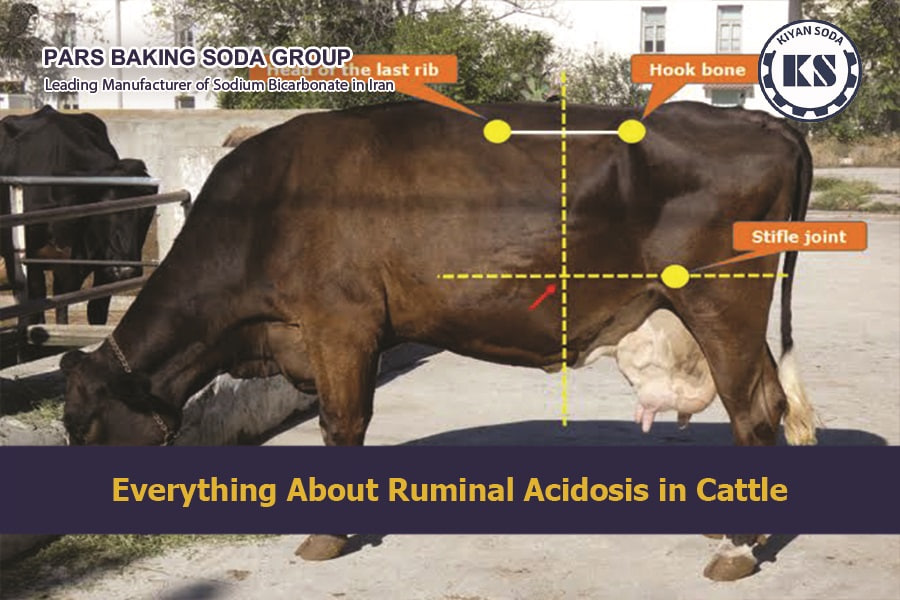
Ruminal acidosis is one of the most important nutritional and metabolic challenges affecting cattle, particularly in intensive dairy and beef production systems. It occurs when the balance between carbohydrate fermentation, acid production, absorption, and ruminal buffering is disrupted, causing rumen pH to fall below an appropriate physiological range. The condition can develop in different forms, ranging from acute ruminal acidosis, which can become a life-threatening emergency, to subacute ruminal acidosis (SARA), which may produce less obvious signs but can negatively affect feed efficiency, milk production, animal health, and herd profitability. Understanding ruminal acidosis in cattle, also referred to as rumen acidosis in cows, is essential for developing effective feeding and herd-management strategies. Diet composition, rapidly fermentable carbohydrates, inadequate physically effective fiber, sudden feed changes, and insufficient adaptation can all increase the risk of excessive ruminal acid production.
What Is Ruminal Acidosis in Cattle?
Ruminal acidosis occurs when fermentation in the rumen produces acids faster than they can be absorbed, neutralized, or otherwise removed. The resulting decline in ruminal pH can disrupt the rumen microbial ecosystem and impair normal digestive function.
Healthy rumen fermentation involves continuous fluctuations in pH, particularly around feeding. However, prolonged or severe reductions in ruminal pH can interfere with microbial activity, fiber digestion, and normal rumen function. The condition is particularly associated with diets containing high levels of rapidly fermentable carbohydrates, including starch-rich feeds and concentrates.
Acute and Subacute Ruminal Acidosis
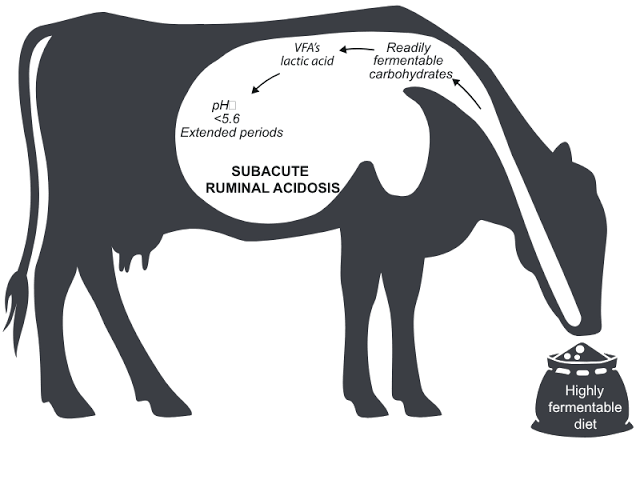
Ruminal acidosis is commonly discussed in two clinically important forms: acute ruminal acidosis and subacute ruminal acidosis. Acute ruminal acidosis develops when a large amount of highly fermentable carbohydrate is consumed over a relatively short period. The resulting accumulation of acids can cause a rapid and substantial decline in ruminal pH and may lead to severe systemic illness.
Subacute ruminal acidosis (SARA) involves repeated or prolonged periods of moderately depressed ruminal pH rather than one dramatic episode. A ruminal pH below approximately 5.8 for several hours per day is commonly used as a practical indicator, although thresholds vary with diagnostic methods, sampling conditions, and interpretation. SARA is particularly relevant in high-producing dairy herds because its signs may be subtle, allowing the condition to persist before a clear clinical problem is recognized.
Causes and Risk Factors of Ruminal Acidosis in Cattle
The development of ruminal acidosis is rarely explained by a single factor. It usually results from an imbalance between fermentable carbohydrate supply, fiber intake, feed management, ruminal adaptation, and the animal’s ability to buffer and absorb fermentation products.
- High Levels of Rapidly Fermentable Carbohydrates
Diets containing substantial amounts of rapidly fermentable carbohydrates can increase the production of volatile fatty acids and, under certain conditions, lactate. If acid production exceeds the rumen’s ability to absorb and buffer these products, ruminal pH can decline.
High-concentrate diets are therefore an important risk factor, especially when they are not properly balanced with adequate effective fiber.
- Inadequate Effective Fiber
Physically effective fiber stimulates chewing and saliva production. Because saliva contains important buffering components, including bicarbonate, adequate chewing activity contributes to the natural regulation of ruminal acidity.
When forage intake or effective fiber is insufficient, cows may spend less time chewing and produce less buffering saliva. This can reduce the rumen’s ability to cope with the acid load generated by fermentation.
- Sudden Feed Changes
Rapid transitions from forage-based diets to high-concentrate rations can increase the risk of ruminal acidosis because the rumen microbial population and digestive system need time to adapt. Gradual dietary transitions are particularly important during periods such as the transition into lactation, when nutritional demands and feed composition may change considerably.
- Feed Management Problems
Even an appropriately formulated ration can create problems when feeding management is inconsistent. Competition at the feed bunk, irregular feeding times, excessive sorting, inadequate mixing, and sudden changes in feed availability can alter individual feed intake patterns. These management factors can increase fluctuations in nutrient intake and contribute to periods of excessive carbohydrate consumption or insufficient fiber intake.
- Excessive Grain or Concentrate Intake
When cattle consume unusually large quantities of grain or concentrate, fermentation can accelerate rapidly. This is particularly dangerous when animals have limited previous exposure to high-concentrate diets. Feed processing, starch availability, ration composition, and the rate at which dietary carbohydrates are fermented can all influence acidotic risk.
Symptoms and Effects of Ruminal Acidosis
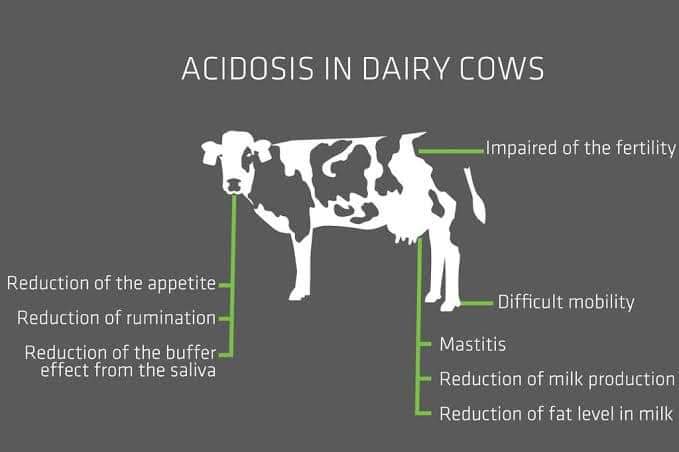
The clinical presentation depends on the severity and duration of ruminal acidification. Acute cases can produce obvious signs of illness, whereas SARA may manifest primarily through changes in production, digestion, manure consistency, and overall herd performance.
Common Signs in Cattle
Depending on the severity of the condition, signs associated with ruminal acidosis may include:
- Reduced feed intake
- Reduced cud chewing
- Loose or inconsistent manure
- Decreased milk production
- Reduced milk fat percentage
- Changes in body condition
- Reduced feed efficiency
- Dehydration and weakness in severe cases
- Reduced rumen motility
- Increased incidence of secondary health problems
SARA is particularly difficult to identify from a single clinical sign because many of its effects are nonspecific. Herd-level patterns and changes in production or feeding behavior may provide more useful warning signals than an isolated symptom.
Health and Production Consequences
Prolonged ruminal acidification can affect more than digestion. SARA has been associated with impaired feed efficiency, reduced milk production, milk fat depression, and an increased risk of other health problems.
The condition may also contribute to inflammatory responses and disorders associated with rumen dysfunction. In some cases, ruminal acidosis has been associated with an increased risk of laminitis and liver abscesses. For dairy producers, these effects can translate into reduced productivity and increased veterinary and management costs.
Diagnosing Ruminal Acidosis in Cattle
Because SARA can occur without dramatic clinical signs, diagnosis should not rely solely on visual observation. A veterinarian or qualified animal nutrition professional may evaluate feeding history, production records, manure characteristics, chewing activity, herd-level patterns, and ruminal pH measurements.
- Monitoring Ruminal pH
Ruminal pH measurement can provide important information about the acid-base status of the rumen. However, pH fluctuates naturally throughout the day, particularly in relation to feeding.
For this reason, the timing, sampling method, number of animals evaluated, and interpretation of results are important. Rumenocentesis has historically been used as a diagnostic method for SARA, although it is invasive, while other approaches and continuous monitoring technologies are also being investigated.
- Evaluating the Ration
A detailed review of the ration is one of the most important steps when ruminal acidosis is suspected. The evaluation should consider:
- Forage-to-concentrate ratio
- Physically effective fiber
- Starch and rapidly fermentable carbohydrate levels
- Feed particle size
- Feed processing
- Ration consistency
- Feed sorting
- Feeding frequency
- Adaptation period
The objective is not simply to reduce dietary starch. High-producing cattle still require sufficient energy, so the ration must balance production requirements with rumen health.
Prevention of Ruminal Acidosis in Cattle
Preventing ruminal acidosis is generally more effective than attempting to manage its consequences after the condition has developed. Prevention depends primarily on ration formulation, gradual dietary adaptation, consistent feeding management, and monitoring of herd performance.
- Maintain Adequate Effective Fiber
Providing sufficient physically effective fiber promotes chewing and saliva production and supports the rumen’s natural buffering system. Forage quality and particle size should therefore be considered alongside the total fiber percentage of the ration. Simply meeting a numerical fiber target does not necessarily guarantee adequate physical effectiveness.
- Introduce High-Concentrate Diets Gradually
Cattle should be given sufficient time to adapt when moving toward diets containing higher levels of concentrates or rapidly fermentable carbohydrates. Gradual transitions allow rumen microorganisms and the animal’s digestive system to adapt to changes in substrate availability and fermentation patterns, reducing the risk associated with sudden dietary changes.
- Maintain Consistent Feeding Management
Consistent access to a properly mixed ration can help reduce large fluctuations in nutrient intake. Feed should be managed to minimize excessive sorting, and feeding schedules should be as consistent as practical. Adequate access to feed and water is also important for maintaining normal intake patterns.
- Monitor Herd-Level Indicators
Early monitoring can help identify problems before they become widespread. Useful indicators may include:
- Feed intake
- Milk yield
- Milk fat percentage
- Manure consistency
- Body condition
- Cud-chewing activity
- Rumen fill
- Incidence of lameness
- Changes in feed sorting behavior
A combination of these indicators is more informative than relying on a single measurement.
Treatment of Ruminal Acidosis

Treatment depends strongly on the severity of the condition. Acute ruminal acidosis can become a serious veterinary emergency. Cattle showing severe weakness, dehydration, depression, recumbency, severe digestive disturbance, or other signs of systemic illness should be evaluated promptly by a veterinarian.
Treatment may involve correcting dehydration and electrolyte disturbances, restoring rumen function, addressing systemic acid-base abnormalities, and correcting the underlying dietary cause. In severe cases, veterinary interventions may include rumen evacuation or other supportive procedures depending on the clinical situation.
For SARA, management generally focuses on correcting the diet and feeding program rather than simply treating low ruminal pH. Identifying excessive carbohydrate load, inadequate effective fiber, poor feed consistency, or inadequate dietary adaptation is essential for preventing recurrence.
Role of Sodium Bicarbonate in Rumen Health
Sodium bicarbonate feed grade is one of the buffering agents used in dairy cattle nutrition. Its relevance comes from the bicarbonate ion, which contributes to acid-base buffering in the rumen.
The cow already has an important natural buffering system through saliva, which supplies bicarbonate and other buffering components. Dietary sodium bicarbonate can complement this system when incorporated appropriately into a balanced ration.
Sodium Bicarbonate for Rumen Health
Sodium bicarbonate for rumen health is primarily relevant as part of a broader nutritional strategy rather than as a standalone solution for ruminal acidosis.
Its buffering action can help support ruminal pH when dietary conditions create an increased acid load. However, sodium bicarbonate cannot compensate for a fundamentally unbalanced ration, inadequate effective fiber, poor feed management, or excessive intake of rapidly fermentable carbohydrates.
Therefore, the first priority in managing acidosis risk should remain appropriate ration formulation and feeding management.
When Is Sodium Bicarbonate Used?
Sodium bicarbonate may be considered in diets where additional buffering capacity is desirable, particularly in high-producing dairy cattle receiving relatively energy-dense rations.
Its inclusion rate should be determined according to the complete diet, sodium supply, animal requirements, and other ingredients. Excessive supplementation can alter dietary sodium balance, so it should be incorporated under appropriate nutritional guidance rather than used indiscriminately. A reliable baking soda manufacturer should provide product specifications suitable for feed applications and consistent quality for nutritional use.
Conclusion
Ruminal acidosis in cattle is primarily a problem of rumen acid-base imbalance associated with excessive acid production, inadequate buffering, and feeding or management conditions that disrupt normal rumen function. High-concentrate diets, rapidly fermentable carbohydrates, inadequate effective fiber, and sudden feed changes are among the most important risk factors. The most effective approach is prevention through balanced ration formulation, gradual dietary adaptation, adequate effective fiber, consistent feed management, and regular monitoring of herd-level indicators.
Sodium bicarbonate can provide additional buffering capacity and has a recognized role in nutritional strategies designed to support rumen health. However, it should complement—not replace—sound ration formulation and feeding management. Selecting a consistent-quality product from an experienced baking soda manufacturer can help nutritionists and feed producers incorporate sodium bicarbonate appropriately into feed programs. For producers and nutrition professionals seeking sodium bicarbonate for rumen health, understanding the complete nutritional context is essential for achieving effective and consistent results.
FAQ
The main risk factors include excessive intake of rapidly fermentable carbohydrates, high-concentrate diets, inadequate physically effective fiber, sudden feed changes, insufficient adaptation, and inconsistent feeding management.
Signs can include reduced feed intake, reduced cud chewing, loose manure, reduced milk production, milk fat depression, poor feed efficiency, weakness, and, in severe cases, dehydration and systemic illness. SARA may produce subtle signs rather than obvious clinical disease.
There is no single pH value that applies to every diagnostic situation because ruminal pH naturally changes throughout the day and depends on sampling conditions. A pH below approximately 5.8 for several hours per day is commonly used as a practical indicator of SARA, but interpretation should consider the sampling method and clinical context.
Prevention focuses on balanced ration formulation, adequate effective fiber, gradual adaptation to high-concentrate diets, consistent feeding management, minimizing feed sorting, and monitoring herd-level indicators.
Acute ruminal acidosis involves a rapid and severe decline in ruminal pH and can become a life-threatening condition. SARA involves repeated or prolonged periods of moderately low ruminal pH and is often associated with longer-term production and health problems.
Sodium bicarbonate can contribute buffering capacity and may help support rumen pH in appropriately formulated diets. However, it should be considered part of an overall feeding strategy rather than a substitute for adequate fiber, proper ration formulation, or good feed management.
It should not be considered a standalone treatment. Acute ruminal acidosis can be a veterinary emergency, and treatment should be determined according to the animal’s clinical condition. Professional veterinary assessment is important in severe cases.
Effective fiber stimulates chewing and saliva production. Saliva supplies natural buffering components that help the rumen manage the acids generated during fermentation.